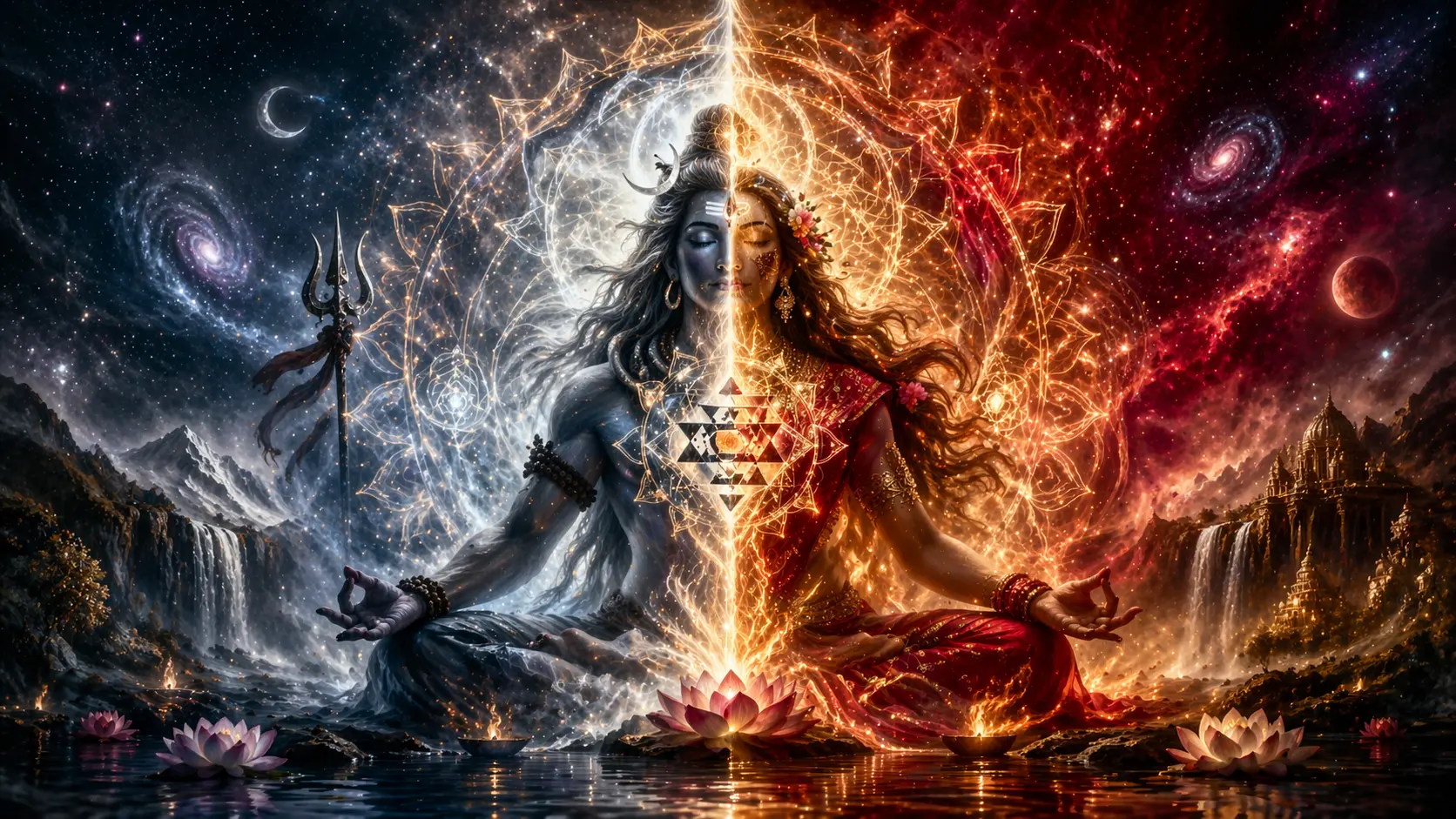
In nearly every image from the classical Tantric tradition, Shiva and Shakti appear together.
Sometimes as two figures in embrace — Ardhanarishvara, the composite deity that is half Shiva, half Parvati (Shakti). Sometimes as the linga and yoni, the abstract symbols of masculine and feminine principle in union. Sometimes as the tantric diagram in which Shiva’s downward-pointing triangle interpenetrates Shakti’s upward-pointing one — the Shri Yantra, which the tradition understands as a map of the entire cosmos.
The ubiquity of this imagery is not devotional decoration. It is a philosophical statement. The entire universe, in the Tantric view, is Shiva-Shakti: two aspects of one reality, inseparable, in perpetual union, whose dance is every moment of existence.
This is one of the most far-reaching ideas in any spiritual tradition. And it has practical consequences that reach into every dimension of human life.
Two Principles, One Reality
In the Kashmir Shaivite understanding — the most philosophically precise articulation of Tantric non-duality — Shiva and Shakti are not two beings. They are two aspects of one movement.
Shiva is pure awareness: the unchanging witness, the still ground, the pure I-consciousness that underlies every experience. Shiva is sometimes described as chit (consciousness) or prakasha (light that illuminates). He is not an actor in the drama of experience. He is the space in which the drama appears.
Shakti is the dynamic creative power of that consciousness: the energy that makes experience possible, the vimarsha (self-recognition) through which awareness knows itself, the force that generates the universe as a continuous act of creative expression. Shakti is not separate from Shiva. She is his own creative nature — the way heat is the nature of fire. You cannot have fire without heat. You cannot have Shiva without Shakti.
The universe, in this view, is not something that happened to consciousness from outside. It is consciousness’s own creative expression — Shakti dancing within the field of Shiva’s awareness. Every experience you have — every sensation, thought, emotion, perception — is this dance.
How This Applies to Your Own Experience
This cosmological framework is not merely abstract. The tradition intends it to be recognized directly.
Within each human being, both principles are present. The awareness that witnesses your thoughts — the one who is reading these words right now, who notices the thoughts arising and passing — is Shiva in you. The energy that moves through your body, that generates sensation and emotion and vitality, that creates and destroys, that rises in creative inspiration and falls in grief — that is Shakti in you.
Tantric practice is, in one sense, the cultivation of their conscious union within your own being: learning to hold the energy of Shakti in the clear light of Shiva’s awareness, rather than being swept away by the energy or dissociated from it.
When the energy is met with awareness — fully felt, not suppressed, not acted out, but held in the spaciousness of witnessing consciousness — something transforms. The energy refines. The awareness deepens. This is the inner hieros gamos, the sacred marriage that the tradition describes: not an external event, but an internal recognition.
Polarity in Relationship
The Shiva-Shakti framework also offers a profound map of human relationship — and one that differs significantly from most contemporary frameworks for intimacy.
Most relational models focus on compatibility, communication, and need-meeting: two people coming together to satisfy each other’s requirements for connection, security, and belonging. These are real needs. But the Tantric framework is interested in something additional: the way two people in genuine polarity can serve each other’s awakening.
When one person is oriented primarily in Shiva principle — presence, stillness, the quality of unwavering witnessing awareness — and the other in Shakti principle — aliveness, creative energy, the fullness of feeling and embodiment — their meeting generates something neither can generate alone. The stillness provides a ground for the energy; the energy activates what was latent in the stillness. Each reveals to the other what they could not see in themselves.
This is the sacred union the tradition is pointing toward: not a merging of two people into sameness, but a meeting of genuine difference that serves the recognition of something beyond both.
A Note on Polarity and Gender
The Shiva-Shakti framework is often assumed to map onto gender: men as Shiva, women as Shakti. The tradition is more nuanced than this, and the nuance matters.
Every human being contains both principles. The most fully developed practitioners in the tradition — male, female, or otherwise — have cultivated depth in both: the capacity for still, spacious awareness and the capacity for full, alive engagement with the energy of Shakti. These are not gendered destinations. They are aspects of a complete human being.
The polarity of Shiva and Shakti operates differently: it describes the dynamic at work in a given moment of relationship, practice, or experience. In one moment, you may hold the stillness while a partner brings the energy. In the next moment, that may reverse. In deep meditation, both are present simultaneously — awareness witnessing the energy that is arising within it.
The cultural history of this framework is complicated by the fact that it has sometimes been used to essentialize gender: to claim that women are inherently energy and emotion, men inherently stillness and spirit. This is not the tradition’s deepest teaching. It is the patriarchal overlaying of a cosmic principle onto a social hierarchy — a distortion that the tradition itself, in its most authentic expressions, does not support.
For Indigenous Canadians who hold traditions of Two-Spirit identity and fluid gender cosmology, the framework’s insistence on the fluidity and co-presence of both principles may be more familiar than its popular distorted form. The tradition at its most complete does not oppose gender wholeness. It presupposes it.
The Practice of Meeting
What does it look like to bring this framework into lived practice?
In your own body, the practice begins with learning to hold the tension between witness and energy — to feel fully without losing the thread of awareness, and to maintain awareness without hardening into distance from feeling. This is the inner sacred union, and it is the work of a lifetime.
In relationship, it begins with a quality of seeing: looking at the person across from you not primarily as a collection of needs and history, but as an expression of Shakti or Shiva — as a manifestation of the living creative force of consciousness. This single shift in perception changes what becomes possible in contact.
In meditation, it manifests as the recognition — at first fleeting, then more stable — that the awareness witnessing experience and the experience being witnessed are not two separate things. They are Shiva and Shakti: one reality appearing as the distinction between knower and known, seer and seen.
That recognition, when it stabilizes, is what the tradition calls liberation.
Why This Matters
The Shiva-Shakti framework matters because it offers something rare in spiritual philosophy: a genuine honoring of both the masculine and feminine principles, neither elevated above the other, neither possible without the other.
In traditions that privilege the transcendent, the formless, the unchanging — which tend to be mapped onto masculine principle — the world, the body, and the feminine are subtly or explicitly devalued. This is the tradition that produced the particular shame around the body and sexuality that many people carry.
Tantra takes the opposite position: the formless is nothing without its creative expression. Shiva without Shakti is a corpse — the tradition says this explicitly. The body is not the obstacle to the sacred. The body is the sacred made available, the creative power of consciousness rendered touchable and breathable and alive.
This is not a philosophy to agree with. It is a reality to recognize — gradually, through practice, in your own direct experience.
And when you do, even partially, it changes everything about how you inhabit your life.
Ready to go deeper?
A 1:1 session brings these teachings to life in your own direct experience. Tailored entirely to where you are on the path.
Explore Sessions