There is a particular cruelty to most spiritual advice for difficult emotional states: it asks the most of people who have the least to give. Meditate for an hour. Maintain a daily practice. Stay consistent.
This path does not ask that of you. What follows are practices chosen specifically for times when energy is low, motivation is absent, and the ordinary architecture of daily life is hard to maintain. They are short. They are simple. They work with you where you are, rather than where you think you should be.
They are also genuinely Tantric — rooted in the tradition’s understanding of prana, the body, and the intelligent movement of life-force through difficult terrain.
The 3-Minute Breath Reset
This is the single most accessible practice for anxiety. It can be done anywhere — sitting in a car, in a bathroom, at a desk.
Inhale through the nose for 4 counts. Hold for 2 counts. Exhale through the nose for 6–8 counts. Repeat.
The extended exhale is the key. It activates the vagus nerve and the parasympathetic response — the nervous system’s own off-switch for the stress response. Three minutes of this is enough to measurably change the physiological state.
Do not wait until anxiety peaks. Use this at the first sign of activation — the tightening chest, the shallow breath, the mind beginning to race. The earlier you catch it, the less momentum it has built.
Floor Contact
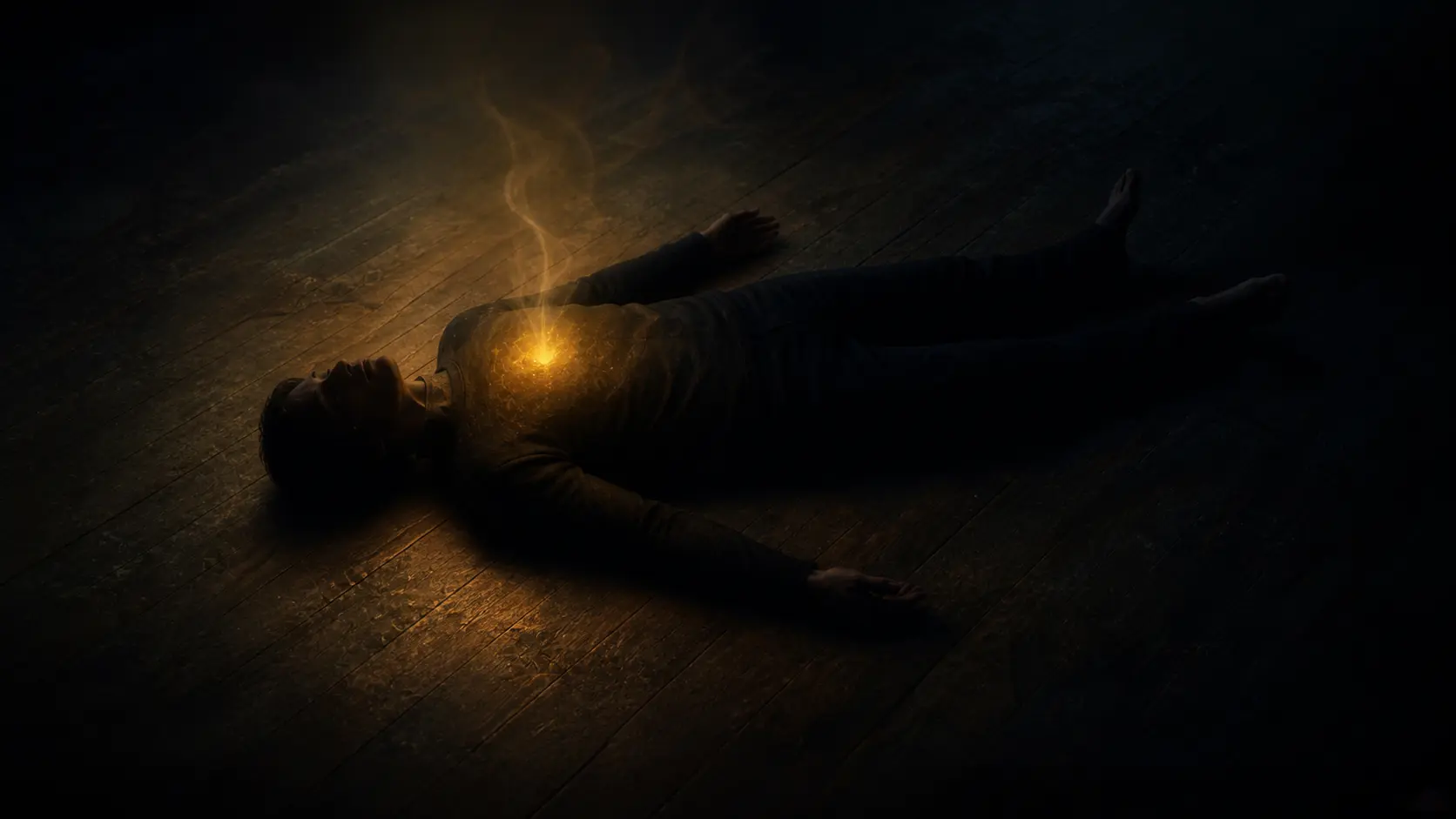
Lie on the floor. This is not a metaphor.
The floor does not require anything of you. It holds your weight completely. It is stable in a way that nothing else in your immediate environment is. And the body, when it encounters genuine physical support, often begins to release a tension it did not know it was holding.
Lie flat on your back. Feel where your body makes contact with the floor — heels, calves, back of the thighs, lower back, upper back, shoulders, back of the head. Let your weight fall. Breathe slowly.
Stay for 5–10 minutes. This is not sleep — stay awake, stay aware of sensation. This is muladhara practice: giving the body the direct experience of being held by something stable.
For depression in particular, this practice carries an additional instruction: keep your eyes open, or half-open. Closing the eyes in a low-energy state often leads to dissociation or sleep. Keep a soft, unfocused gaze at the ceiling. Stay in contact.
The So Hum Breath
So Hum is among the oldest and most accessible mantras in the tradition. It means, roughly, “I am that” — a two-syllable pointing toward the non-dual teaching that the individual self and the larger awareness are not ultimately separate.
Its power in difficult states is less philosophical than sonic. The sounds So (on the inhale) and Hum (on the exhale) are the natural sounds the breath already makes — you are not imposing something foreign, but becoming conscious of what is always already happening.
Practice: Breathe in, and silently hear So. Breathe out, and silently hear Hum. Let the breath be natural — don’t control it. Just listen to the mantra within it.
10 minutes of this practice reliably shifts the quality of inner attention from the anxious or depressive mind’s self-referential loop toward something quieter. Not transcendence — just a slight loosening of the grip of the contracted state.
Warmth and Self-Holding
The body responds to warmth as safety. This is not sentiment — it is biology, present from birth. The nervous system reads warmth as contact, as not-alone.
Simple practice: Place one hand over the centre of your chest. Place the other on your belly. Feel the warmth of your own hands through your clothing. Breathe.
This is not a trick. It is contact — your own system meeting itself with care. For people who spend most of their time at war with their inner experience, this gesture of simple physical kindness can open something that is difficult to open any other way.
Stay for 3–5 minutes. If emotion arises, let it. The practice is not to control what happens but to stay present with whatever does.
Small Movement
Depression in particular responds poorly to demands for sustained effort — but it does respond to movement, even very small movement.
Five minutes of slow, deliberate movement is enough: gentle neck rolls, slow arm circles, rocking the pelvis, rolling the spine vertebra by vertebra. Not exercise. Not performance. Just the body moving in ways that feel natural and releasing.
The Tantric understanding is that prana follows movement — where the body moves, energy begins to circulate. Even minimal movement in a depleted system can begin to shift the stagnation that depression creates.
If you can move outdoors — a 10-minute walk at any pace — this is even more effective. The combination of physical movement, contact with natural environment, and light works directly with the muladhara and manipura systems simultaneously.
A Note on Consistency
With anxiety and depression, consistency matters more than duration. Five minutes of breath practice every day is worth more than an hour of practice done once a week. The nervous system learns through repetition of experience — small, regular inputs gradually reshape the baseline.
Do not wait to feel better before beginning. Begin where you are, with what you have. The path through dark times is walked in the dark — not from the other side of it.
These practices do not promise to eliminate anxiety or lift depression. They promise something more modest and more real: that if you bring consistent, gentle attention to your body’s actual experience, you give prana the conditions it needs to begin to move again.
And when prana moves, things change. Not always dramatically. Not always quickly. But in the direction of life.
Ready to go deeper?
A 1:1 session brings these teachings to life in your own direct experience. Tailored entirely to where you are on the path.
Explore Sessions